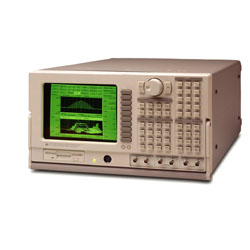
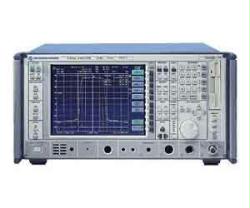
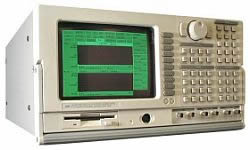
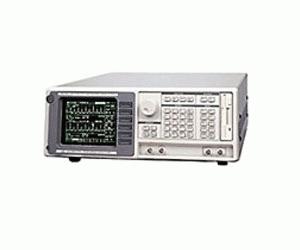
The SR780 Dynamic Signal Analyzer combines high performance and low cost in a full-featured package. It offers 102.4 kHz dual-channel FFTs with 90 dB dynamic range, 145 dB dynamic range swept-sine measurements, real-time ANSI standard octave analysis, waterfall displays and transient capture for less than half the cost of other similarly equipped analyzers.
Whether your application involves acoustic measurements, vibration testing, servo systems or filter design, the SR780’s features, performance and low cost are unmatched.
Features and Specifications of the Stanford Research SR780 Dynamic Signal Analyzer include:DC to 102.4 kHz bandwidth
90 dB dynamic range
Low-distortion synthesized source
145 dB dynamic range in swept-sine mode
Real-time octave analysis
Up to 32 Mbyte memory
GPIB and RS-232 interfaces
Measurement Groups:
FFT: FFT, Time Record, Windowed Time, Time Capture, Transfer Function, Cross Spectrum, Coherence, Cross-Correlation, Auto-Correlation, Orbit, User Math
Octave Analysis: 11/1, 1/3, 1/12 Octave, Time Capture, User Math, Leq, Impulse, Total Power
Swept-Sine: Spectrum, Transfer Function, Cross Spectrum, User Math
FFT Resolution: 100, 200, 400, 800 lines
Views: Linear Magnitude, Log Magnitude, Magnitude Squared, Real Part, Imaginary Part, Phase, Unwrapped Phase, Nichols, Nyquist
Units: V, V2, V2/Hz, V/vHz, meters, inches, mils, g, kg, lbs., N, dynes, pascals, bars, SPL, user-defined engineering units (EUs)
Displays: Single, Dual, Waterfall with Skew, Zoom and Pan
Averaging: RMS, Vector, Peak Hold, Linear, Exponential, Equal Confidence (Octave), Preview Time Record
Triggering: Continuous, Internal, External (Analog or TTL), Source, Auto/Manual Arming
Source Outputs: Sine, Two-Tone, Swept-Sine, White/Pink Noise, Burst Noise, Chirp, Burst Chirp, and Arbitrary
Windows: Hanning, Blackman-Harris, Flat-Top, Kaiser, Force/Exponential, User-Defined, +/-T/2, +/-T/4, T/2, Uniform
User Math: +, -, ×, /, Conjugate, Magnitude/Phase, Real/Imaginary, Sqrt, FFT, Inverse FFT, jO, Log, Exp, d/dx, Group Delay, A-, B-, C-Weighting, x/x-1
Analysis: Harmonic, Band, Sideband, THD, THD + N, Limit Test with Pass/Fail, Data Table, Exceedance, Statistics
Time Capture: Captures time data for later analysis (FFT or Octave). Up to 2 Msamples (8 Msamples optional) of data can be saved.
Storage: 3.5", 1.44 Mbyte, DOS formatted disk. Save data and setups.
Frequency:
Range: 102.4 kHz or 100 kHz (both displays have the same range)
FFT Spans: 195.3 mHz to 102.4 kHz or 191 mHz to 100 kHz. The two displays can have different spans and start frequencies.
FFT Resolution: 100, 200, 400 or 800 lines
Real-Time Bandwidth: 102.4 kHz (highest FFT span with continuous data acquisition and averaging)
Accuracy: 25 ppm from 20 °C to 40 °C
Dynamic Range:
Range: 90 dB typical, 80 dB guaranteed (FFT and Octave). 145 dB (Swept-Sine). Includes spurs, harmonic and intermodulation distortion and alias products. Excludes alias responses at extremes of span.
Harmonic Distortion: <-80 dB (single tone in band)
Intermod Distortion: <-80 dB (two tones in band, each less than -6.02 dBfs)
Spurious: <-80 dBfs
Alias Responses: <-80 dBfs (single tone outside of span, <0 dBfs, less than 1 MHz)
Full-Span FFT Noise Floor: -100 dBfs typ. (input grounded, >-30 dBV, Hanning window, 64 rms averages)
Residual DC Response: <-30 dBfs (FFT with Auto-Cal on)
Amplitude Accuracy:
Single Channel: ±0.2 dB (excluding windowing)
Cross Channel: ±0.05 dB (transfer function measurement, both inputs on the same range, rms averaged, DC to 102.4 kHz)
Phase Accuracy:
Single Channel: ±3.0 deg. relative to external TTL trigger (-50 dBfs to 0 dBfs, frequency <10.24 kHz, center of frequency bin, DC coupled). For Blackman-Harris, Hanning, Flat-Top and Kaiser windows, phase is relative to a cosine wave at the center of the time record. For Uniform, Force and Exponential windows, phase is relative to a cosine wave at the beginning of the time record.
Cross Channel:
±0.5 deg. (DC to 51.2 kHz)
±1.0 deg. (DC to 102.4 kHz)
(transfer function measurement, both inputs on the same input range, vector averaged)
Signal Inputs:
Number of Inputs: 2
Full-Scale Input Range: -50 dBV (3.16 mVp) to +34 dBV (50 Vp) in 2 dB steps
Maximum Input Level: 57 Vp
Input Configuration: Single-ended (A) or differential (A-B)
Input Impedance: 1 MO + 50 pF
Shield to Chassis:
Floating mode: 1 MO + 0.01 µF.
Grounded mode: 50 O. Shields grounded in (A-B) mode
Max Shield Voltage: 4 Vp
AC Coupling: 0.16 Hz cutoff frequency
CMRR:
90 dB at 1 kHz (input range <0 dBV)
80 dB at 1 kHz (input range <10 dBV)
50 dB at 1 kHz (input range =10 dBV)
ICP Signal conditioning:
Current Source: 4.8 mA
Open Circuit Voltage: +26 V
A-Weight Filter: Type 0 tolerance, ANSI standard S1.4-1983 (10 Hz to 25.6 kHz)
Crosstalk: <-145 dB below signal (input to input and source to inputs, 50 O receiving input source impedance)
Input Noise: <10 nVrms/vHz above 200 Hz (<-160 dBVrms/vHz)
Trigger Input:
Modes: Free run, Internal, External, or External TTL
Internal: Level adjustable to ±100 % of input scale, positive or negative slope.
Min Trigger Level: 5 % of input range
External: -Level adjustable to ±5 V in 40 mV steps, positive or negative slope.
Input Impedance: 1 MO
Max Input: ±5 V
Min Trigger Amplitude: 100 mV
External TTL: Requires TTL level to trigger (low <0.7 V, high >3.0 V)
Post-Trigger: Measurement record is delayed up to 8192 samples after the trigger.
Pre-Trigger: Measurement record starts up to 8192 samples prior to the trigger.
Transient Capture:
Mode: Continuous data recording
Maximum Rate: 262,144 samples/s for both inputs
Maximum Capture Length:
2 Msamples (single input)
8 Msamples with optional memory
Octave Analysis:
Standards: Conforms to ANSI standard S1.11- 1986, Order 3, Type 1-D and IEC 225-1966
Frequency Range (Band Centers):
Single Channel:
1/1 Octave : 0.125 Hz to 32 kHz
1/3 Octave : 0.100 Hz to 40 kHz
1/12 Octave : 0.091 Hz to 12.3 kHz
Two Channels:
1/1 Octave : 0.125 Hz to 16 kHz
1/3 Octave : 0.100 Hz to 20 kHz
1/12 Octave : 0.091 Hz to 6.17 kHz
Accuracy: <0.2 dB (1 second stable average, single tone at band center)
Dynamic Range: 80 dB (1/3 Octave, 2 second stable average) per ANSI S1.11-1986
Sound Level: Impulse, Peak, Fast, Slow and Leq per ANSI S1.4-1983 Type 0 and IEC 651-1979 Type 0
Source Output:
Amplitude Range: 0.1 mVp to 5 Vp
Amplitude Resolution: 0.1 mVp (output >500 mVp)
DC Offset: <10.0 mV (typ)
Offset Adjust: ±5 VDC (sine, two-tone)
Output Impedance: <5 O, ±100 mA peak output current
Sine Source:
Amplitude Accuracy:
±1 % of setting, 0 Hz to 102.4 kHz
0.1 Vp to 5.0 Vp, High-Z load
Harmonics, Sub-harm & Spurious:
0.1 Vp to 5 Vp
<-80 dBc (fundamental <30 kHz)
<-75 dBc (fundamental <102 kHz)
Two-Tone Source:
Amplitude Accuracy:
±1 % of setting, 0 Hz to 102.4 kHz
0.1 Vp to 5 Vp, High-Z load
Harmonics, Sub-harm:
<-80 dBc
0.1 Vp to 2.5 Vp
White Noise Source:
Time Record: Continuous or burst
Bandwidth: DC to 102.4 kHz or limited to span
Flatness:
<0.25 dBpp (typ.)
<1.0 dBpp (max.)
5000 rms averages
Pink Noise Source:
Bandwidth: DC to 102.4 kHz
Flatness: <2.0 dBpp, 20 Hz to 20 kHz (measured using averaged 1/3 Octave Analysis)
Chirp Source:
Time Record: Continuous or Burst
Output: Sine sweep across the FFT span
Flatness: ±0.25 dB (amplitude: 1.0 Vp)
Swept-Sine Source:
Auto Functions: Source level, input range and frequency resolution
Dynamic Range: 145 dB
Arbitrary Source:
Amplitude Range: ±5 V
Record Length: 2 Msamples (playback from arbitrary waveform memory or capture buffer). Variable output sample rate.
General:
CTR Monitor: Monochrome, 800H by 600V resolution
Interfaces: IEEE-488.2, RS-232 and printer interfaces standard. All instrument functions can be controlled through computer interfaces. A PC (XT) keyboard input is provided for additional flexibility.
Hardcopy: Print to dot matrix and PCL compatible printers. Plot to HP-GL or postscript plotters. Print/plot to RS-232 or IEEE-488.2 interfaces or to disk file. Additional file formats include GIF, PCX and EPS.
Disk: 3.5" DOS format, 1.44 Mbytes
Preamp Power: Power connector for SRS preamps
Power: 70 W, 100/120/220/240 VAC, 50/60 Hz