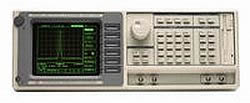
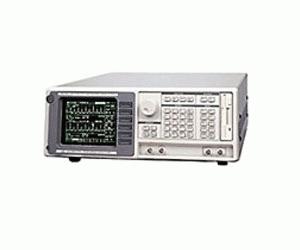
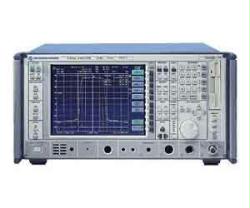
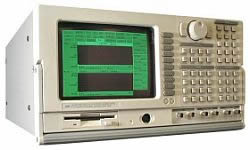
The Stanford Research Systems (SRS) SR770 is a single-channel 100 kHz FFT spectrum analyzer with a dynamic range of 90 dB and a real-time bandwidth of 100 kHz. The speed and dynamic range of this analyzer, coupled with its flexibility and many analysis modes, makes it the ideal choice for a variety of applications including acoustics, vibration, noise measurement and general electronic use.
Features and Specifications of the Stanford Research SR770 Spectrum Analyzer include:
DC to 100 kHz bandwidth
90 dB dynamic range
Low-distortion synthesized source
Harmonic, band and sideband analysis
100 kHz real-time bandwidth
Hardcopy output to printers and plotters
GPIB and RS-232 interface
Frequency:
Measurement Range: 476 µHz to 100 kHz
Spans: 191 mHz to 100 kHz in a binary sequence
Center Frequency: Anywhere within the 0 to 100 kHz measurement range
Accuracy: 25 ppm from 20 °C to 40 °C
Resolution: Span/400
Window Functions: Blackman-Harris, Hanning, Flat-Top and Uniform
Real-time Bandwidth: 100 kHz
Signal Input:
Number of Channels: 1
Input: Single-ended or differential
Input Impedance: 1 MO, 15 pF
Coupling: AC or DC
CMRR (at 1 kHz):
90 dB (input range <-6 dBV)
80 dB (input range <14 dBV)
50 dB (input range =14 dBV)
Noise:
Typ: 5 nVrms/vHz at 1 kHz (-166 dBVrms/vHz)
Max: 10 nVrms/vHz (-160 dBVrms/vHz)
Amplitude:
Full-Scale Input Range: -60 dBV (1.0 mVp) to +34 dBV (50 Vp) in 2 dB steps
Dynamic Range: 90 dB (typ)
Harmonic Distortion: No greater than -80 dB from DC to 100 kHz (input range 0 dBV)
Spurious: No greater than -85 dB below full scale below 200 Hz. No greater than -90 dB below full scale to 100 kHz (input range -50 dBV).
Input Sampling: 16-bit A/D at 256 kHz
Accuracy: ±0.3 dB ± 0.02 % of full scale (excluding windowing effects)
Averaging: RMS, Vector and Peak Hold. Linear and exponential averaging up to 64k scans.
Trigger Input:
Modes: Continuous, internal, external, TTL
Internal Level: Adjustable to ±100 % of input scale. Positive or negative slope.
Min Trigger Amplitude: 10 % of input range
External Level: ±5 V in 40 mV steps. Positive or negative slope. 10 kO Impedance
Min Trigger Amplitude: 100 mV
External TTL: Requires TTL level, (low <0.7 V, high >2 V)
Post-Trigger: Measurement record is delayed by 1 to 65,000 samples (1/512 to 127 time records) after the trigger. Delay resolution is 1 sample (1/512 of a record).
Pre-Trigger: Measurement record starts up to 51.953 ms prior to the trigger. Delay resolution is 3.9062 ms.
Phase Indeterminacy: <2°
Display Functions:
Display: Real, imaginary, magnitude or phase
Measurements: Spectrum, power spectral density, time record and 1/3 octave
Analysis: Band, sideband, total harmonic distortion and trace math
Graphic Expand: Display expand up to ×50 about any point
Harmonic Marker: Displays up to 400 harmonics
Data Tables: Lists Y values of up to 200 points
Limit Tables: Detects data exceeding up to 100 user-defined upper and lower limit trace segments.
Source:
Amplitude Range: 0.1 mVp to 1.0 Vp
Amplitude Resolution: 1 mVp (output >100 mVp),
0.1 mVp (output <100 mVp)DC Offset: <10.0 mV (typ)
Output Impedance: <5 O, 50 mA peak output current
Sine Source:
Frequency Range: DC to 100 kHz
Resolution: 15.26 mHz
Amplitude Accuracy: ±1 % (0.09 dB) of setting
Spectral Purity:
Harmonics: -80 dBc, f <10 kHz
Sub-Harmonics: -70 dBc, f >10 kHz
Spurious: < -100 dB full scale
Two-Tone Source:
Frequency Range: DC to 100 kHz
Resolution: 15.26 mHz
Amplitude Accuracy: ±1 % (0.09 dB) of setting
Spectral Purity:
Harmonics: -80 dBc (f <10 kHz)
Sub-Harmonics: -70 dBc (f >10 kHz)
Spurious: < -100 dB full scale
White Noise Source:
Frequency Range: DC to 100 kHz (all spans)
Flatness: <1.0 dBpp (rms averaged spectra)
Pink Noise Source:
Frequency Range: DC to 100 kHz (all spans)
Flatness: <4.0 dBpp (using 1/3 oct. analysis)
Chirp Source:
Output: Equal amplitude sine waves at each
frequency bin of the current spanFlatness: <0.05 dBpp (typ), <0.2 dBpp (max)
Phase: AutoPhase function calibrates to
current phase spectrum.General:
Monitor: Monochrome CRT. 640H by 480V resolution. Adjustable brightness and position.
Interfaces: IEEE-488.2, RS-232 and Printer interfaces standard. An XT keyboard input is provided for additional flexibility.
Hardcopy: Screen dumps and table and setting listings to dot matrix and LaserJet compatible printers. Data plots to HP-GL compatible plotters (RS-232 or IEEE-488.2).
Disk: 3.5" DOS compatible format, 1.44 Mbyte (720 kbyte for the SR760) capacity. Stores data and instrument configurations.
Power: 60 W, 100/120/220/240 VAC, 50/60 Hz